Industrial and warehouse lighting · 12 September 2025 · 8 min read
High-bay LED selection for Australian warehouses
Optics, mounting height, aisle versus open hall, IP and IK — how to specify a high-bay that still works when a forklift looks up at 2 a.m.
By Tom Brennan, Industrial and WHS correspondent, Perth, Western Australia
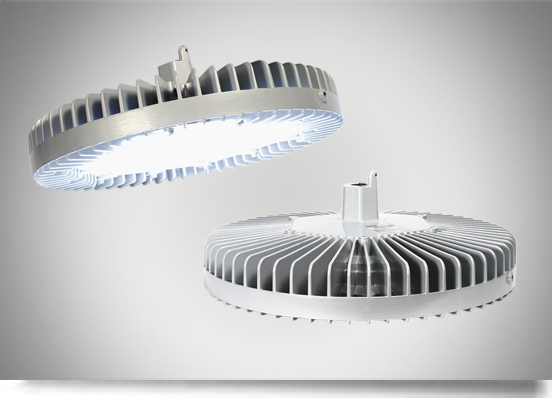

Most Australian warehouse lighting specifications still begin with a wattage. “Replace the 400 W metal halide with a 150 W LED high-bay.” That sentence is a procurement habit, not a design. The hall is not one visual task. A picker reading a barcode, a reach-truck driver looking into a rack, and a night cleaner on an empty dock each need a different distribution and a different glare story.
This essay is a working method for high-bay selection on Australian industrial sites. It sits in the industrial and warehouse hub and should be read with LED total cost of ownership before anyone signs a payback sheet.
Name the hall before you name the lumen package
Start with geometry. Record mounting height to the light-emitting face, not to the underside of the truss a salesperson photographed. Record aisle width, rack height, and whether the building will still be an open hall in three years. Plenty of Perth and western-Sydney sheds are leased as open storage and racked six months later. An optic chosen for an empty box then lights the floor and leaves the pick face in twilight.
Typical Australian industrial mounting heights, as briefing language rather than a substitute for calculation:
- 6 m to 8 m: often a linear low-bay or a wide high-bay. Glare is the usual failure, not raw lux.
- 8 m to 12 m: the common high-bay band for regional distribution centres. Aisle optics start to matter.
- 12 m to 16 m: beam control and a real aiming plan, or you are lighting the slab for a drone.
- Above 16 m: treat it as a flood and a maintenance problem. Access equipment will dominate the audit and relamping conversation.
Set the working plane where the work is. Pallet identification sits on a vertical face. A marshalling desk sits at 0.75 m. A floor-only false-colour plot is how you approve a hall that looks bright from the mezzanine and fails at the pick slot.
AS/NZS 1680 still applies. Circulation, bulk storage, packing and inspection are different categories. Write the maintained illuminance and the uniformity for each, then pick the optic that can deliver them after a maintenance factor that assumes forklift dust, not a showroom.
Aisle optics are not open-hall optics
An open hall wants a wide, reasonably symmetrical distribution and a ceiling that does not glitter. An aisle wants a long, narrow or aisle-optic distribution that throws light down the lane and onto the vertical faces. The two problems share a mounting height and almost nothing else.
If you hang a 90-degree high-bay over a 2.8 m aisle, you get a bright stripe on the slab and a driver who cannot read the top beam. If you hang a tight aisle optic over an open cross-dock, you get tiger stripes.
Ask for a polar curve and a layout on this aisle module. A “120 degree high-bay” badge is marketing. You need candela at the angles that hit the pick face and a cut-off that keeps the source out of the driver’s windshield. If the manufacturer will not calculate your rack height, do not accept a generic 150 W substitution. Very-narrow-aisle systems need vertical light on both faces and a source that does not sit in the field of view when looking up.
Forklift glare is a WHS issue, not a comfort complaint
A high-bay that looks acceptable from the floor can still disable a driver looking up into a rack at 2 a.m. The eye meets the luminaire at an angle no UGR table was asked about. Polished concrete and shrink-wrap make it worse. Specify a shielded or refracted optic, not a bare board behind a cheap lens. Walk the aisle with the mast up. If you only stand in the driveway, you will approve a hall that fails the first night shift.
High-output “one-for-one” replacements are the usual offender. The metal halide they replace was a glowing bulb in a reflector. The LED is often a small, vicious source. Drop the lumen package, tighten the optic, and add a fitting if the calculation needs it. Energy is not saved if drivers slow down or leave bays lit with portable floods.
IP, IK and the climate the datasheet never saw
Australian warehouses are not German showrooms. Coastal sheds take salt. Inland sheds take dust that cakes a ribbed heatsink. Tropical sheds cook fittings under a roof the European LM-80 file never contemplated. Write an ingress and impact rating that matches the room.
- Dry storage: IP65 is a reasonable starting point. The driver still needs a thermal story.
- Dusty bulk, grain, recycling and open docks: treat IP65 as a minimum. A finned housing that never gets cleaned is a heater.
- Washdown, food and cold: go to cool-room and food-process lighting.
- Impact: IK08 is common talk; IK10 is what you write when a reach truck will kiss a fitting.
Ask how the fitting is sealed, whether the optic yellows, and what happens when a board fails — module swap or whole luminaire. The import warning is a no-name high-bay with no spare driver and a colour that drifts to green after two summers under a Colorbond roof. 4000 K is the usual Australian industrial default. Inspection and print-on-pack want a higher CRI and sometimes 5000 K. Do not mix temperatures down one aisle because two contractors bought remaining stock.
Emergency, controls and the thing that is not a high-bay
A high-bay with an emergency pack is convenient on a drawing and miserable at 14 m when the pack fails. Design industrial emergency and exit lighting as its own system. A generator that keeps the high-bays alive is not an AS/NZS 2293 strategy unless the circuit and the testing are written that way. The standards hub is where that argument belongs.
Controls are where warehouse retrofits quietly fail. Occupancy sensors that see a forklift as absence, and a “turn everything off at 10 p.m.” scene that leaves a pick face dark, are common. Zone by aisle. Give the night shift a scene that does not assume the day-shift lux. Absence detection should match travel time down an 80 m aisle, not a meeting-room default.
If you are writing a retrofit against old HID, do the total cost of ownership properly: energy, access equipment, out-of-hours work, and the residual life of the switchboard. A cheap high-bay that needs a boom every time a driver fails will lose to a dearer fitting with a locally supported spare.
What to write in the specification
Steal this structure and then edit it for the shed you are actually lighting:
- Name the building use, racking, and whether the layout is allowed to change.
- Name each visual task and the maintained illuminance on a stated plane — floor, desk or vertical pick face.
- Name mounting height, optic family (open, aisle, VNA), and a glare method that includes a driver looking up.
- Name IP, IK, ambient temperature, and the maintenance factor with a cleaning cycle someone will fund.
- Name emergency strategy separately from the high-bay schedule.
- Name controls zones, night scenes, and who is allowed to override them.
- Name spare modules, driver availability in Australia, and the measurement protocol at completion.
Require a layout on the real aisle module, not a typical bay. Ban “equivalent” substitutions that keep the wattage and lose the optic. If value management wants to swap an aisle optic for a UFO, make them rerun the vertical-face calculation.
Measurement and the mistakes we keep seeing
A single lux reading in an empty aisle is theatre. Use a cosine-corrected meter, a grid that includes rack ends and the top beam, and a night measurement with the doors shut. Walk at the height a driver sits. If night-shift operators have taped cardboard under a fitting, you have a glare defect.
One optic for a mixed hall. A lumen package copied from a 400 W metal halide without a glare check. IP20 indoor high-bays in a dusty regional shed. Emergency packs at 14 m with no access strategy. Treating workshop lighting and WHS duties as a separate building when the maintenance shop is in the same shed.
A high-bay is a tool for a named task at a named height. Everything else is a catalogue page. Read the aisle, then buy the optic.
Questions readers ask
- Can one high-bay optic serve both aisles and an open hall?
- Rarely. Aisle racks need a long, narrow distribution that puts light on vertical pick faces. An open hall wants a wide, even pool. Using one optic for both usually leaves dark racks or a glittering floor.
- What mounting height do I need before I stop using a low-bay?
- Treat about 6 m as the hinge. Below that, a low-glare low-bay or linear usually behaves better. From 8 m to 16 m a true high-bay optic is the starting point, provided you name the aisle width and the working plane.
- Do warehouse high-bays need emergency packs?
- Many do, but a self-contained pack at 12 m is a maintenance problem. Design the escape lighting as its own system under AS/NZS 2293 and decide early whether packs, a central battery or a generator-backed circuit will actually be tested.
More in Industrial and warehouse lighting
- Cool-room and food-processing lighting in Australia
IP69K, washdown, condensation and the colour of meat — lighting that survives a food plant without lying about produce.
- Workshop lighting and WHS duties for Australian PCBUs
Task lighting, shadow, flicker and rotating machinery — what a PCBU actually has to get right under Australian WHS law.
- Industrial emergency and exit lighting under AS/NZS 2293
How emergency lighting behaves in dusty, cold, generator-backed industrial sites, and what the 2293 logbook is for.