Outdoor and civic lighting · 4 June 2025 · 8 min read
Sports field and court lighting in Australia
Community cricket, AFL and tennis lighting — lux classes, glare to residents, and the difference between a training night and a broadcast fantasy.
By Tom Brennan, Industrial and WHS correspondent, Perth, Western Australia
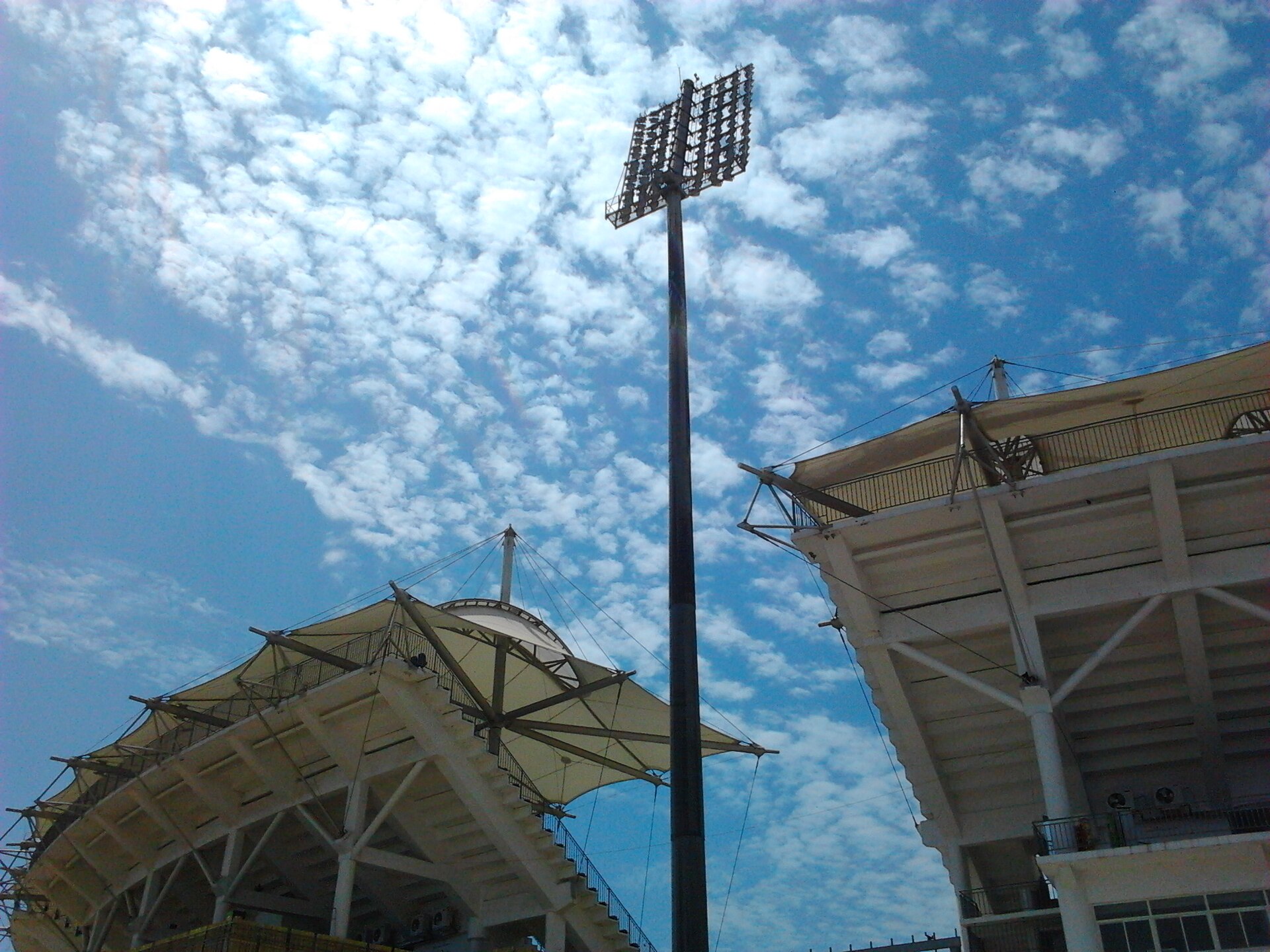

Community sport after dark is a public good and a glare machine. The club wants midweek training, a Friday night game and a social tennis roster. The houses on the hill want the same night they had before the LED grant. The council wants both, plus a dark-sky sentence in the strategy, plus a capital budget that assumed a one-for-one swap of the old 2 kW floods. Australian ovals add a further complication: the same reserve often hosts cricket in summer, AFL or football in winter, and a diamond or a rectangular field that does not match the pole grid.
This essay is a WHS and neighbour method for community fields and courts. It sits on the outdoor and civic hub with car parks, facades and precincts. It is not a broadcast-design manual. If someone has promised television lux on a suburban cricket ground, stop and name the class again.
Name the sport and the class
AS 2560 is the Australian sports lighting family. Open the current parts that apply to the codes on the reserve, then the sport’s own community guide. Cricket Australia, AFL, Football Australia and Tennis Australia are more specific about ball speed than a vendor’s “meets 100 lux” slide. Do not treat a blog number as the standard.
Typical community conversations, not substitutes for the current documents, run like this:
- Training and social play: a lower maintained class, still even enough that a ball is trackable and a trip hazard is visible.
- Club competition: a step up, with tighter uniformity and better vertical light on the ball.
- Regional or semi-pro: higher again, sometimes with a television conversation you should not fake.
- Recreational tennis: a court class that is about seeing a yellow ball against a dark backstop, not about looking like a show court.
Cricket is unkind to lighting. A red or pink ball against a night sky, a sight screen, and fielders looking up will punish a luminaire that sits in the view of the sky. Poles in the wrong place become the ball. AFL and other football codes want a readable ground, vertical light on a high ball, and less glare for a player looking into a pack. Tennis wants a high, even court, a dark enough surround that the ball contrasts, and no flood in the server’s eyes. A shared reserve that uses one aiming diagram for all three will fail at least one of them.
Write maintained illuminance, uniformity, and a glare method for each class. Write the maintenance factor. Community fields are dusty, and nobody cleans a flood. Initial readings on opening night should be higher than the class, or July will be under-lit.
Indoor courts sit closer to AS/NZS 1680. Do not copy an outdoor flood package indoors.
Glare to players and to residents
Players need to see the ball, not the lamp. Residents need to not see the lamp. Those are the same optic conversation. A narrow, aimed, well-shielded LED with a sensible mounting height can put light on the field and keep intensity out of the bedroom and out of a batter’s eyes. A cheap wide flood on a short pole will do the opposite on both counts.
AS/NZS 4282 thinking belongs in the first week, not after the petition. Name the nearest windows, the measurement planes, and the after-hours curfew. A 9 p.m. training finish is a different neighbour than a 10:30 p.m. Friday game plus a 40-minute warm-down with the lights left on. Write the off-time in the hire agreement and in the control software. The most common community complaint we see is not the game. It is the lights still on at 11:20 p.m. because someone forgot the last switch.
Higher poles, properly aimed, often reduce spill because the beam can be steeper. Residents hear “taller” as “worse”. Bring a section drawing. Do not “solve” a dark corner with a flood on the clubhouse — that is a facade mistake. Light the clubhouse as an entry on a hospitality curfew; see restaurants and hotels. Car parking is a CPTED task. A brilliant oval next to a dark gravel park is how a parent walks to the car with a phone torch.
LED retrofit of old HID fields
Most community ovals still remember metal halide. Those lamps were slow, hungry, and surprisingly forgiving of sloppy aiming because the blob was large. LED is faster, cheaper to run, and less forgiving. A one-for-one “equivalent wattage” that copies a 15-degree tilt will create a hot centre, a dark pocket at the boundary, and a new glare source the MH’s milky outer bulb had softened.
Relight the field. Recalculate spacing, height and aiming. 4000 K is common on Australian fields because it feels close to daylight. 5000 K looks “crisper” on a drone shot and harsher for neighbours. This is not a retail colour problem, but a red cricket ball still has to separate from a maroon jumper.
Instant-on LED is the neighbour feature: HID made clubs leave lights up through a break. LED can drop to training, then off, if the control exists.
Controls, hire and the last team off the field
A community reserve without addressable scenes will be run as “all on” by whoever has the key. Specify:
- Training, competition and, if needed, maintenance / grounds scenes.
- Per-sport scenes on a shared reserve.
- A time clock with a hard off and a short, logged override for injury or a late finish.
- A photocell that does not turn the oval on at 4 p.m. in June and leave it there.
- A hire system that can grant a scene without granting a breaker.
DALI or a robust sports controller is cheaper than a year of complaints. If the oval sits in a campus or precinct, interlock the sports scene so it cannot be used as campus wash. Energy claims for LED sports lighting are easy to invent. Meter a season. Section J may touch building-mounted court lighting; the big oval is still a tariff and a grant-acquittal story. Tell it with hours.
Grandstand emergency lighting is a building problem. Do not let a sports grant swallow that scope and then omit it.
Cricket, AFL and tennis on one piece of land
Shared reserves fail when the poles are a compromise nobody modelled. Cricket wants corners and a sight screen that is not a luminaire. AFL wants a boundary that moves with the season. Tennis wants less spill from the oval and its own cut-off. Draw all three season layouts before you pour footings. A midweek training scene should not be the Saturday competition scene. School courts used after hours need the off-time in the joint-use agreement.
On a Perth suburban oval with summer cricket, winter football and two tennis courts we refused a single 100 lx average. Three sports scenes, a shielded tennis package, taller poles with tighter optics, a hard 9:15 p.m. training off, and a car park relit as a pedestrian task. The grant called it an “LED upgrade”. The brief called it a relight.
What to write in the specification
- Name each sport, each class, and the edition of AS 2560 plus the sport’s community guide.
- Name maintained illuminance, uniformity, glare for players, and the maintenance factor.
- Name residential receivers, AS/NZS 4282 limits, pole height rationale and lockable aiming.
- Name scenes, hard off-times, hire overrides and the interlock with any precinct lighting.
- Name the car park, the clubhouse terrace and the path to the street as part of the project.
- Name a night mock-up or first-game hold point with the club and a resident representative.
Measurement on the first night
Measure the field on a grid, at the class, with a cosine-corrected meter, after a warm-up if the spec still has HID anywhere. Then stand in the batter’s stance, the goal square and the baseline and look at the lamps. Then stand at the nearest bedroom plane you can legally occupy and look again. If you only drone the oval for the grant acquittal, you will certify a bright paddock and a sleepless street.
Community sport is allowed to be seen. It is not allowed to become the suburb’s night light. Pick the class the club will play, aim at the ball, shield the houses, and switch the scene off when the last player has left the car park.
Questions readers ask
- Can a community oval use the same lights as a televised ground?
- Almost never, and it should not try. Broadcast classes are a different visual task, a different glare limit and a different neighbour fight. Design the class the club will actually play.
- What do I say to residents who can see the field from bed?
- That aiming, shielding, curfew and a calculated AS/NZS 4282 assessment are part of the brief, not a later apology. If those cannot be met, the pole height or the class is wrong.
- Is one lux number enough for cricket, AFL and tennis on a shared reserve?
- No. The ball, the background and the viewing distance change. Write a class per sport and a control scene per sport, or you will over-light tennis and still lose a cricket ball in the sky.
More in Outdoor and civic lighting
- Car-park lighting for safety and energy in Australia
CPTED, uniformity and the LED-versus-HID decision for Australian open and covered car parks — a method that starts with faces and cameras, not a pole catalogue.
- Facade, architectural and flood lighting
How to wash an Australian facade without spilling into bedrooms, flattening heritage stone or leaving a flood on a timer that nobody owns.
- Precinct, campus and public-realm lighting
How Australian campuses and councils light paths, plazas and wayfinding without flattening the night or ignoring dark-sky and neighbour duties.