Outdoor and civic lighting · 8 September 2025 · 8 min read
Car-park lighting for safety and energy in Australia
CPTED, uniformity and the LED-versus-HID decision for Australian open and covered car parks — a method that starts with faces and cameras, not a pole catalogue.
By Tom Brennan, Industrial and WHS correspondent, Perth, Western Australia
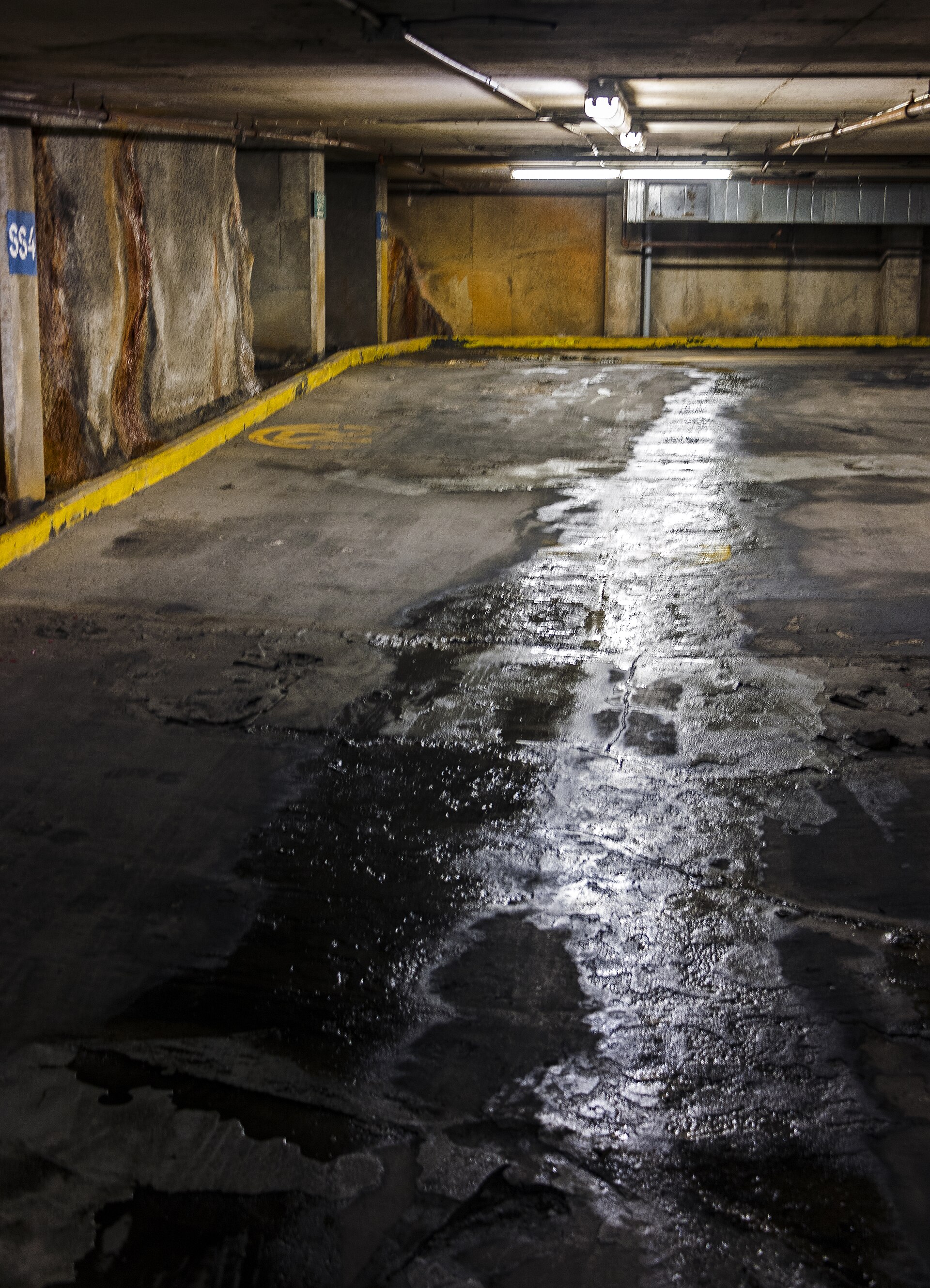

A car park at 11 p.m. is a workplace, a public room and a potential crime scene. The question is not “how many lumens on the slab”. It is whether a person can see a face, a number plate and a shadow between the vans, and whether the neighbour can still sleep. Australian parks retrofitted a lot of HID very quickly, and still treat uniformity as optional if the average looks healthy on a drone shot.
This essay is a field method for open and covered car parks. It lives on the outdoor and civic hub with facades, precincts and sports fields. Energy and controls sit with Section J and DALI or BMS where the park is attached to a building. Retail parks on the retail and hospitality hub should also read the supermarket and showroom notes — the trolley walk and the night yard are the same walk.
CPTED is a lighting brief
Crime prevention through environmental design is not a police poster you attach to a DA. It is a set of seeing tasks. People should see and be seen. Cameras should see a face, not a blown-out puddle under a luminaire. Hiding places — behind a stair, between a high-top van and a column, under a dark ramp — should not be darker than the aisle a security guard walks.
Write those tasks before you pick a pole. Typical Australian car-park categories, used as briefing language rather than a substitute for the current standard, look like this:
- Entry and payment: faces, tickets, a readable screen, a camera that works in rain.
- Pedestrian aisles from bay to lift or trolley bay: vertical light, even enough that a person is not a silhouette against a bright exit.
- Vehicle aisles and ramps: guidance, glare that does not hide a pedestrian stepping out, a surface that remains readable when wet.
- Isolated corners, bike cages and fire stairs: the places HID economy left dark.
Open AS/NZS 1158 for outdoor pedestrian and public parking categories, and AS/NZS 1680 for many covered parks. The CPTED sentence is what stops you lighting the driving lane like a runway and the pedestrian island like an afterthought. Vertical illuminance on a standing face is the number security actually needs. Place calculation points at face height along the walk, not only on the asphalt.
Uniformity, glare and the van problem
An average that looks legal can hide a 4:1 or worse ratio between the stall under the luminaire and the stall under the concrete beam. The eye adapts to the bright patch. The rest of the park feels like a cave. That is why “we measured 40 lux at the boom gate” is not a survey.
Specify a uniformity target and a calculation that includes the real obstructions: deep beams in a 1970s podium, signage soffits, solar canopies, and the forest of SUVs that will park on day one. Software that assumes an empty slab is a brochure. Ask for a parked-car case, or at least a note that vehicles will invent shadows.
Glare is how parks fail at night even when they are “bright”. A flood tilted to chase a dark corner will sit in the windscreen of every incoming driver and in the eyes of a pedestrian crossing the aisle. Covered parks add low soffits and glossy paint. If the source is visible at 20 degrees from horizontal, you have designed a complaint. Use a full cut-off or a proper car-park optic. Ban the adjustable “security flood” on a wall bracket unless it has a visor, a lock, and a drawing that shows the tilt.
Dark asphalt will not match the software’s default 0.2. Guess honestly — the same office warning about reflectances.
LED versus the HID you are replacing
Most Australian open parks still remember 250 W or 400 W metal halide or high-pressure sodium on a 8–12 m pole. Those lamps threw a lot of light in all the wrong directions, took minutes to restrike, and made everything either yellow or a tired blue-white. LED fixes the restrike and the watts. It does not automatically fix the geometry.
A one-for-one LED “equivalent” that copies the old aiming will usually be too punchy in the middle and still dark at the edge, because the old HID distribution was a blob and the new LED is a sharper optic. Sometimes that is good — less spill to the neighbour. Sometimes it is a new dark stall. Relight the park. Change spacing if you must. Use the energy saving to pay for a pole, not only a lamp.
4000 K became the Australian default because it looked “safe” next to leftover MH. 3000 K often glares less and is kinder to dark-sky and precinct work. Do not specify 5000 K to “feel brighter”. Read CRI and TM-30 if the park sits on a civic plaza; faces still need to be identifiable.
LED boards can go out in patches or shift green. Specify lumen maintenance, a replaceable module, and a night-scouting clause. A dead luminaire is a CPTED hole, not a decorative defect.
Covered parks, podiums and the residential neighbour
Podium car parks under apartments are the Australian special. The soffit is low, the paint is tired, and the bedrooms sit around the void. Light that escapes the entry ramp or the perimeter grill is obtrusive light under AS/NZS 4282 thinking. Residents will describe it as “the car park laser”. They are not wrong if you used a wide-beam batten with no house-side shield.
Use a true cut-off, a warmer CCT at the perimeter, and a night setback. Presence detection is good if it does not plunge a pedestrian into darkness between detections. A hold, a timeout, and a residual scene beat a binary on/off.
The wattage is easy to cut with LED. The way to cut it without a WHS hole is controls and optics, not a darker average. Write the maintained target and the setback as two numbers.
Energy, hours and the empty Sunday
Car parks have long hours and bursty occupancy. That is the opposite of an office. A static LED retrofit still wins against HID on watts. A controlled LED wins again on the empty Sunday afternoon and the 3 a.m. level. Use photocells on the open park (with a fail-on), time clocks that match actual trade, and occupancy on covered levels that have a safe residual scene.
If the park serves a hospitality venue, coordinate with the last sitting. A park that goes to 10 per cent while a kitchen is still breaking down is a WHS fail. A vendor’s “up to 80 per cent” is not a baseline.
On a Perth shopping centre we inherited 400 W MH on the roof and yellow battens below. We refused a one-for-one. The roof was relit to a pedestrian category with full cut-off 3000 K. Covered levels got a residual scene and occupancy that did not punish a slow walker. Cameras got vertical targets at the lifts. The west boundary got a house-side shield and a 10 p.m. step-down. The CPTED walk happened at 9 p.m. with a guard who already knew the dark stall.
What to write in the specification
- Name the standard edition (1158 and/or 1680), the council overlay, and AS/NZS 4282 if light can leave the lot.
- Name each seeing task: entry, pedestrian aisle, vehicle aisle, stair, bike cage, ramp.
- Name maintained horizontal and vertical illuminance, uniformity, and the glare / cut-off method.
- Name CCT, a modest colour-fidelity target for identification, and the optic — not only watts.
- Name scenes, occupancy, photocell fail-safe, and the Section J or NABERS claim.
- Name maintenance access, a dead-luminaire response time, and a night survey at practical completion.
Measurement that is not a drone shot
Survey at night, with cars parked if you can borrow a fleet. Use a grid, a cosine-corrected meter, and a vertical reading at face height on the walk to the lift. Stand where a driver waits at the boom and where a pedestrian steps out from between two utes. Photograph toward the luminaires; if the camera blooms, so will eyes.
A single reading under a new LED is theatre. Light the face, even the stall, cut the spill, and treat the empty hour as a control problem. That is a car park. The pole catalogue is a consequence.
Questions readers ask
- Is a high average lux a safe car park?
- No. A bright patch under each luminaire and a dark stall between them is how people feel watched in the wrong places. Specify uniformity and vertical light on faces, then the average.
- Do I still need HID thinking for a LED retrofit?
- You need the old aiming and the old glare, because they are why the park failed. A one-for-one LED that copies a 400 W flood will save watts and keep the complaint.
- Which standard applies to an Australian car park?
- Open parks and many outdoor circulation areas sit with AS/NZS 1158. Covered parks often sit with AS/NZS 1680. Obtrusive light sits with AS/NZS 4282. Read the current editions and the council overlay; do not inherit a single number from a vendor slide.
More in Outdoor and civic lighting
- Facade, architectural and flood lighting
How to wash an Australian facade without spilling into bedrooms, flattening heritage stone or leaving a flood on a timer that nobody owns.
- Precinct, campus and public-realm lighting
How Australian campuses and councils light paths, plazas and wayfinding without flattening the night or ignoring dark-sky and neighbour duties.
- Sports field and court lighting in Australia
Community cricket, AFL and tennis lighting — lux classes, glare to residents, and the difference between a training night and a broadcast fantasy.